|
|
| Line 2: |
Line 2: |
| | The following is important information for the DIY rider. Quite often a seemingly impenetrable electrical problem can be traced to a battery that is no longer serviceable. This should be the first thing you look at. | | The following is important information for the DIY rider. Quite often a seemingly impenetrable electrical problem can be traced to a battery that is no longer serviceable. This should be the first thing you look at. |
| | | | |
| − | Sometimes a battery just dies. Not necessarily from neglect, age, or use. It just dies. This normally comes from sulfates building up along the bottom and shorting out a couple of the lead plates. It's difficult for many people to trouble-shoot because they'll just toss a voltmeter on the battery and see that it shows 12v DC and right away say it's fine. Here's a bad battery (this one died WHILE the bike was running!). It's being tested with a [http://en.wikipedia.org/wiki/Multimeter multimeter] to find the [[How to read a multimeter|voltage drop]]. | + | Sometimes a battery just dies. Not necessarily from neglect, age, or use. It just dies. This normally comes from sulfates building up along the bottom and shorting out a couple of the lead plates. It's difficult for many people to trouble-shoot because they'll just toss a voltmeter on the battery, see that it shows 12v DC and right away say it's fine. The truth is, if the resting voltage (after sitting, not on a charger) is below 12.2, that battery needs to be replaced. Below 12v and it's dead, for all practical purposes. |
| | + | |
| | + | To confirm the death, do a little more investigating. Here's a bad battery (this one died WHILE the bike was running!). It's being tested with a [http://en.wikipedia.org/wiki/Multimeter multimeter] to find the [[How to read a multimeter|voltage drop]]. |
| | | | |
| | Fresh off the battery tender. 13v is good. | | Fresh off the battery tender. 13v is good. |
| Line 12: |
Line 14: |
| | [[Image:IMG_3398.JPG|170px]] | | [[Image:IMG_3398.JPG|170px]] |
| | | | |
| − | ...and starter thumbed. This is the "drop" part of the equation. You shouldn't see lower than<br> about 10v DC: | + | ...and starter thumbed. This is the "drop" part of the equation. You shouldn't see lower than<br> about 10v DC. |
| | | | |
| | [[Image:IMG_3400.JPG|170px]] | | [[Image:IMG_3400.JPG|170px]] |
| | | | |
| | 6 volts isn't good. Time to head to [[What kind of battery should I use?|the battery store]]. | | 6 volts isn't good. Time to head to [[What kind of battery should I use?|the battery store]]. |
Revision as of 11:04, 22 September 2007
The following is important information for the DIY rider. Quite often a seemingly impenetrable electrical problem can be traced to a battery that is no longer serviceable. This should be the first thing you look at.
Sometimes a battery just dies. Not necessarily from neglect, age, or use. It just dies. This normally comes from sulfates building up along the bottom and shorting out a couple of the lead plates. It's difficult for many people to trouble-shoot because they'll just toss a voltmeter on the battery, see that it shows 12v DC and right away say it's fine. The truth is, if the resting voltage (after sitting, not on a charger) is below 12.2, that battery needs to be replaced. Below 12v and it's dead, for all practical purposes.
To confirm the death, do a little more investigating. Here's a bad battery (this one died WHILE the bike was running!). It's being tested with a multimeter to find the voltage drop.
Fresh off the battery tender. 13v is good.
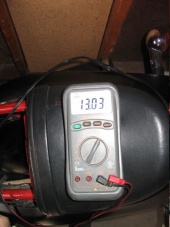
Ignition on. 12v. Only a slight drop.
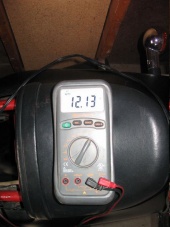
...and starter thumbed. This is the "drop" part of the equation. You shouldn't see lower than
about 10v DC.
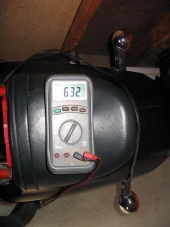
6 volts isn't good. Time to head to the battery store.


